How to: Curious Stories for Kids
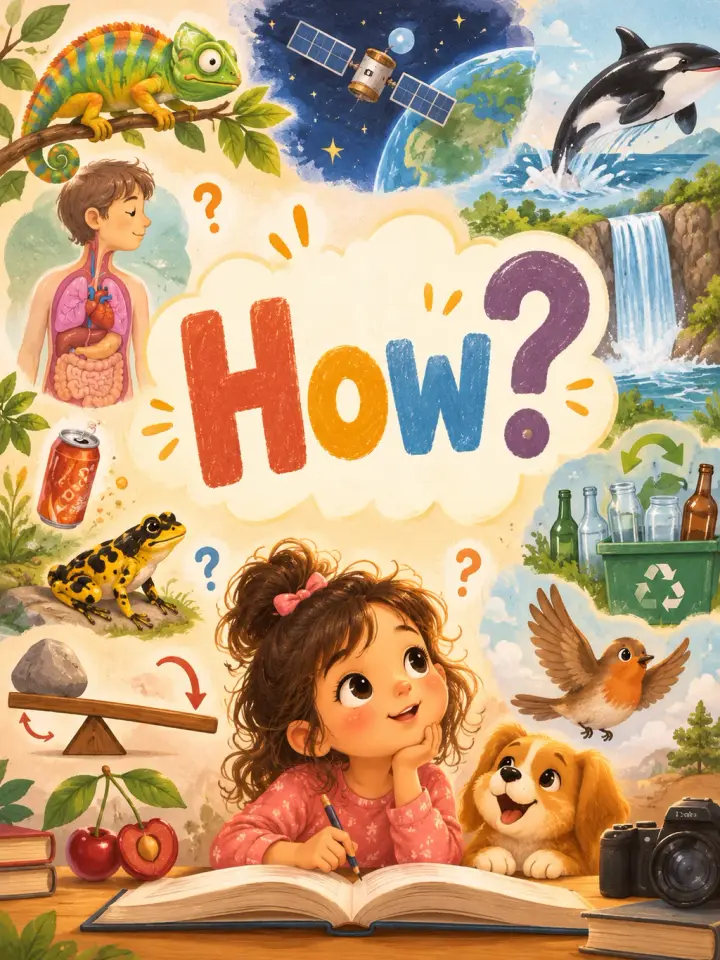
Big questions make wonderful stories. How to gathers short, illustrated explanations of the things children notice every day: how airplanes fly, how trees help bring rain, and how mirrors show reflections. Each story takes one question and follows it step by step.
Hear stories like these in your voice
Record your voice once, and NinniTales can tell stories from its library in it, even on the nights you can't be there.
In this collection

How Can Something So Heavy Fly?
A child looks up at a heavy passenger airplane and discovers how lift, weight, thrust, and drag work together to keep it flying.

How Do Trees Help Bring Rain?
Follow a drop of water from a tree's roots to its leaves, into a cloud, and back to Earth as rain.

How Does a Mirror Show Your Reflection?
A curious child discovers how light bounces from a face to a smooth mirror and back to the eyes, creating a reflection.

How Clouds Float?
How Clouds Float? is a short nonfiction science story told directly to the listener, with no invented characters. It starts with a puzzle: a single large cloud can hold hundreds of tons of water, as heavy as dozens of elephants, so why doesn't it fall? The story first explains how clouds form, as the Sun warms rivers, lakes, and oceans, water turns into invisible water vapour (evaporation), rises, cools, and turns back into tiny droplets or ice crystals (condensation). It then reveals the secret: a cloud is not one giant ball of water but countless tiny droplets spread across a huge space, each falling so slowly that the air and rising currents keep them up, much like a speck of dust in a sunbeam. When droplets bump together and grow too big, gravity pulls them down as rain, or as snow in colder conditions. A final fact about fast-moving clouds and a closing question about why some clouds turn dark grey leave the child with a new mystery to wonder about.

How Flowers Get Color
This short non-fiction story begins in a garden of red roses, yellow sunflowers, and purple violets and asks who gives flowers their colors. The narrator explains that nobody paints the petals: tiny pigments inside the flower's cells do the work, with anthocyanins helping make reds, purples, and sometimes blues, and carotenoids helping make yellows and oranges. Children then learn that sunlight contains many colors, that petals absorb some of that light and reflect the rest, and why white flowers look white. The story also shows how bright petals attract bees and butterflies, which carry pollen from flower to flower and help plants make seeds. It closes with a new puzzle to think about: why are most leaves green?

How Exercise Helps Us
How Exercise Helps Us is a short non-fiction explainer that speaks directly to the child, with no characters or plot. It starts with a familiar feeling, a heart going thump-thump after running around the playground, then explains what is happening inside the body. The heart beats faster to carry oxygen-rich blood to working muscles, and regular activity helps muscles and bones grow stronger. The story also says that moving is good for the brain and mood. It finishes by reminding children that dancing, cycling, swimming, skipping, and playing outside all count as exercise, then asks a new question: why do we sweat when we run and play?

How Rainbows Form
This non-fiction learning story starts as the rain stops, the clouds clear, and a rainbow appears across the sky. A friendly narrator asks who painted the colors, then explains the real answer step by step. White sunlight is made of many colors mixed together, and it bends as it enters a raindrop, bounces off the inside, and bends again on the way out, spreading into red, orange, yellow, green, blue, indigo, and violet. The story introduces the words refraction and dispersion, and explains why rainbows do not follow every rainfall and why two people never see exactly the same one. It closes with a new question to wonder about: why does the sky look blue during the day?

How Dolphins Sleep
This non-fiction learning story starts with a puzzle: dolphins spend their whole lives in the ocean, yet they breathe air and cannot breathe underwater, so how do they sleep? The story explains that dolphins must stay aware enough to surface and breathe through their blowhole, so only one half of the brain sleeps at a time while the other half stays alert. Scientists call this unihemispheric sleep. Children also learn that dolphins can sleep with one eye open, that the two sides of the brain take turns resting, and that a sleeping dolphin may float near the surface like a log or swim very slowly. The story adds that some dolphin species can live to around 50 years, and it closes with a new question about how enormous whales sleep.
Start with one big question
Children can look at an airplane and ask how something so heavy can fly. They can notice rain in a forest and wonder what trees have to do with it, or smile into a mirror and ask why it shows their face. These stories follow each question through familiar examples.
Each story stands on its own. Choose the question your child is asking tonight, read it together, and leave room for the next one.
Read or listen together
The full story is available to read on this site. In the Ninni Tales app, a parent can choose to hear a story narrated in their recorded voice after giving consent for voice cloning.
The words are written for curious young listeners and keep the explanation close to what they can picture.
Frequently asked questions
What is in the How to collection?
It includes illustrated stories about how airplanes fly, how trees help bring rain, and how mirrors show your reflection. More question-led stories will join the collection as they are published.
Can I read these stories without the app?
Yes. The complete story text is on the website. The app offers narration in a recorded parent voice when a family chooses that feature.